
It goes without saying that staying strong and physically active is one of the most important things we can do for our health and longevity. There are many ways to achieve this, and the media is awash with the latest trends. Isometric exercise is currently one of them that is making the news. But what exactly is it, why is it suddenly being talked about, and can everyone benefit?
What does isometric actually mean?
A type of muscle contraction where the muscle generates force without changing its length or causing movement of the associated joint.
Most exercise involves the joints moving in one way or another: walking, running, bicep curls, squats etc. Isometric exercise, by contrast, does not. It is a type of strength training where there is no movement in the joints, but the muscles are still contracting to hold you in position. Perhaps the most well known example is a plank.
If you’re looking for a way to stay strong, improve balance, and protect your joints, then isometric exercises could be something to add into your exercise routine.
Why are ‘isometrics’ being talked about?
When I first qualified as a personal trainer, isometric training was seen as something to be wary of for clients with high blood pressure. At that time, the rationale was that because holding a static contraction causes blood pressure to increase, it was thought to be damaging. More recently, there has been extensive research, which challenges this theory. It is these new findings that have hit the headlines.
When doing isometric exercises, there is a temporary restriction of blood flow, know as ischemia, in the muscles that are working and, it is true, a corresponding increase in blood pressure. However, when the contraction is then released, there is a ‘rebound’ increase in the flow of blood. Over time, this helps reduce stiffness in the arteries, helping them to dilate more easily, allowing the blood to flow with less resistance. The heart does not have to work as hard to pump the blood around, and so blood pressure improves.
Aside from this there are a number of other benefits to be had:
- Low impact on joints – isometric movements don’t involve repetitive motion or impact, and are therefore easier on the joints. In addition, they can be a safe way to strengthen the muscles around your joints, giving them more support and reducing discomfort.
- Building strength without heavy weights – isometrics rely mostly on body weight, meaning they are both convenient and effective.
- Bone health – like all weight- bearing exercise, isometric holds stimulate the growth of new bone tissue, helping to slow age-related bone loss that can lead to osteoporosis.
- Mental focus – because isometrics involve stillness and controlled breathing, they encourage a mind-body connection.
Getting started
Here’s a short isometric routine covering upper body, lower body and core. It is suitable for all fitness levels but always check with your GP before starting a new exercise program, especially if you have health conditions.
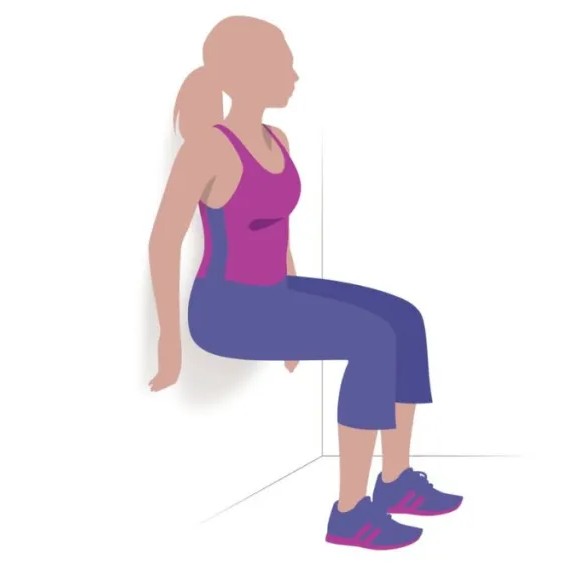

1. Wall Sit (build up to 1 minute)
Stand with your back against a wall. Slide down until ideally your knees are at a 90-degree angle and your heels are directly under your knees, so your toes are visible at the front.
If this feels too low, go down just as far as you can.
Keep the tummy lightly drawn in and the back in contact with the wall throughout. Hold and breathe.
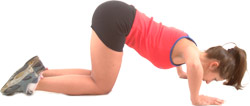
2. Box press or 3/4 press up (build up to 30 seconds)
Start on all fours with the hands wider than shoulder width and the weight over the hands.
Draw the shoulders down and bend the elbows out to the side. Hold half way down. Try not to let the bottom drop back.
If this feels too easy, slide your knees further back, hands still wider than shoulder width as above, keeping the weight over your hands. Drop your bottom (not too low) to make a straight line from your shoulder to your knees (like a 3/4 plank position). Bend the elbows and hold as above.
3. Plank (build up to 1 minute)
Planks can be done with straight arms like the picture above, or with the lower arm on the floor.
Hands are shoulder width apart, tummy is drawn up to engage the abdominals, shoulders drawn down away from the ears.
Keep the neck long and try not to let the head drop too low. Hold still.
If this is too challenging, drop the knees down to the floor
You can repeat the sequence 2–3 times, depending on how you feel.
Final thoughts
There are many exercise trends that are definitely over-hyped. I would say that isometric exercise is not one of them. It is a gentle (that doesn’t necessarily mean easy though!), accessible, and extremely effective tool to build strength, protect joints and help to reduce blood pressure. What’s more, by timing yourself, you will be able to clearly see your progress – always uplifting and motivational….just ask the Wednesday night walk and toners who, starting from 20 seconds just 8 weeks ago, are about to break the minute mark with their planks!
Yup!! Totally agree 😊A great addition to any exercise programme! A good tip to avoid BP rising excessively is exhale on the hard part and avoid breath holding.
Thanks for the reminder Julia – absolutely, correct breathing is key and makes all the difference on so many levels.